
BHPW Newsletter Q3 2026
MARKET RECAP
Global equities treaded water during the third quarter, as strength in several areas of the world economy was offset by the twin headwinds of higher interest rates and rising oil prices. Stocks spent most of the period in a narrow 3% trading range, and the MSCI ACWI ultimately finished up 1.6%.
Beneath the surface, results were far less steady. The median stock in the S&P 500 finished the quarter roughly -16% below its 52-week high, and just four stocks drove the entirety of the market’s gain. Without them, the ACWI would have declined nearly -2% for the quarter.
Elsewhere, bonds faced a tougher period. The 10-year Treasury yield rose by 85 basis points, climbing from 4.44% to 5.29%. It was the largest quarterly increase since 1994, and bond prices fell as a result, with the US and Global Aggregate indices declining by -3.5% and -2.5%, respectively.
For our part, performance was relatively stable across our equity and fixed income models. In equities, the narrow market leadership worked against our more diversified mandate. Meanwhile, in fixed income, our higher yields and strong security selection helped cushion the impact of this period’s rising rates.
MUSICAL CHAIRS
We started this letter with the story of a 10-year, 10% bond changing hands through a bull market. Ashley and Ben each earned 20% or more in a single year, not because the bond’s cash flows supported that result, but because the next buyer was willing to pay a higher price – and accept a lower return.
What the story did not illustrate was this process in reverse. If the required return rises back to 8% a year later, Charlie would end the year with a loss. If it rose to 10%, his decline would be significant. And in either case, if he holds the bond to maturity, Charlie would still earn the 6% annualized return he originally anticipated.
This has essentially been the experience of bond investors over the past five years, as the 10-year Treasury yield has risen from 1.5% to 5.3%. The government’s promise to repay did not change; newer bonds simply began offering much higher yields, forcing older bonds to temporarily fall in price to compete. The silver lining is that the very same forces that pushed bond prices lower have now made them considerably more attractive for investors going forward.
THE EQUITY VERSION
Interestingly, the same basic mechanics apply to stocks, with one important difference: a company’s cash flows can grow over time. But the stock price can rise even faster when investors are willing to pay more for each dollar of earnings.
There is nothing inherently wrong with that. A business may deserve a higher valuation because its competitive position has strengthened, its growth prospects have improved, or uncertainty has declined. But just as Ashley’s 22% return did not mean she had purchased a 22% investment, strong historical returns do not tell us what investors should expect to earn from today’s stock prices.
Instead, a useful starting point is the earnings yield. Stocks have recently experienced the opposite dynamic from bonds, with rising prices pushing yields lower. As a result, the S&P 500 now trades at about 26x trailing earnings – equivalent to an earnings yield of just 3.8%, and well below its long-term average of roughly 7%.
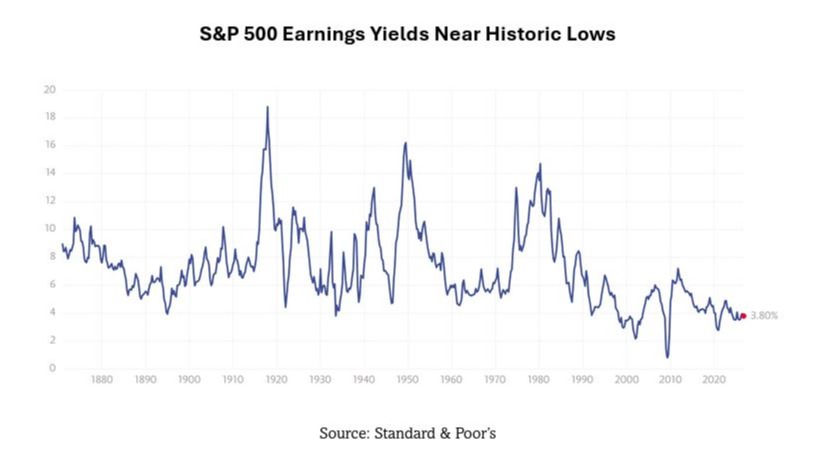
Of that 3.8% earnings yield, about 2.4% is returned to S&P 500 shareholders each year through dividends and share repurchases. If the remainder is reinvested to grow earnings roughly in line with the economy – about 6% in nominal terms – the result would be a long-term return of about 8.5% per year, assuming valuations remain constant.
RELATIVE VALUE
Taken together, the two major asset classes now sit near opposite ends of their historical ranges. Bond yields are near their highest levels in decades; stock earnings yields are near historic lows; and the gap between them has flipped meaningfully in favor of the 10-year Treasury. Said another way, bonds are now cheaper relative to stocks than at any point in the past 24 years, as the chart below illustrates.
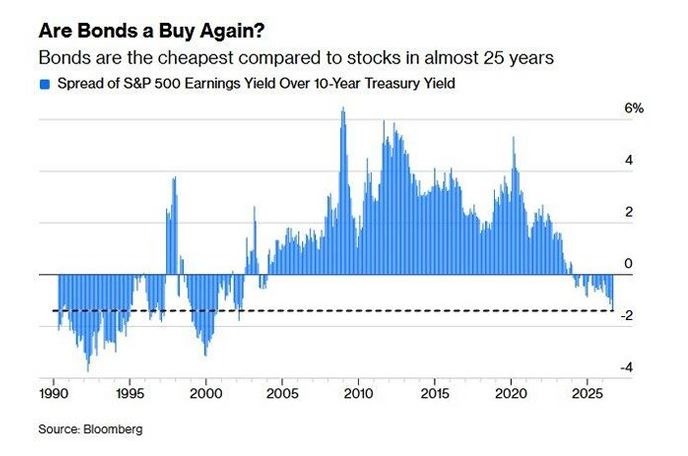
That does not mean bonds will necessarily outperform stocks from here, or that fixed income will not continue to experience some near-term volatility. But it does mean the opportunity set has changed, as investors can now reliably earn roughly 6%-8% in relatively low-risk fixed income investments. We think those returns compare favorably with the high-single-digit returns implied by broad equity valuations, particularly when held in nontaxable accounts.
For stocks to meaningfully outperform that high-single-digit hurdle, one of two things likely has to happen: valuations have to rise even further (which is hard to underwrite), or corporate earnings have to grow at a sustainably faster rate.
THE AI OPPORTUNITY
The clearest opportunity for earnings growth to exceed historical norms is artificial intelligence. AI has the potential to raise productivity, accelerate discovery, and create entirely new products and services. If it can lift the economy’s long-term growth rate even modestly, that should ultimately translate into faster earnings growth – and higher returns – from today’s prices.
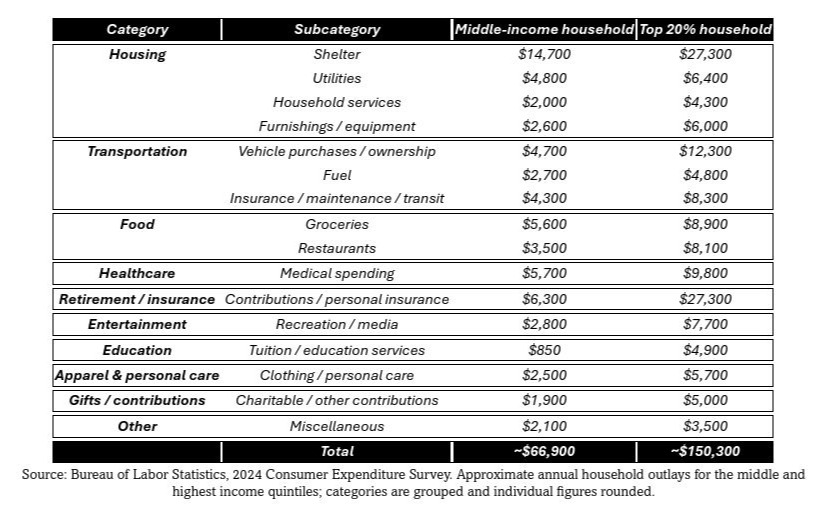
The question is whether those gains will be large enough to justify the expectations already priced into equities. We think that remains far from certain, given how much household spending (see table below) remains tied to the physical economy.
Our best estimate is that AI could add roughly 1%-2% per year to economic growth over time – an enormously meaningful contribution, but one that would likely still leave broad stock market returns in the high single digits. That would do little to change the relative appeal of stocks versus bonds at today’s valuations.
THE OTHER SIDE OF HIGHER YIELDS
There is also another side to higher yields that may strengthen the case for bonds. The same rates that make bonds more attractive now also raise the hurdle rate for borrowers and investors throughout the economy. As the chart below illustrates, periods of higher interest rates have often been followed by recessions (shaded areas) and sharp rate cuts, which can subsequently boost the returns on fixed income.
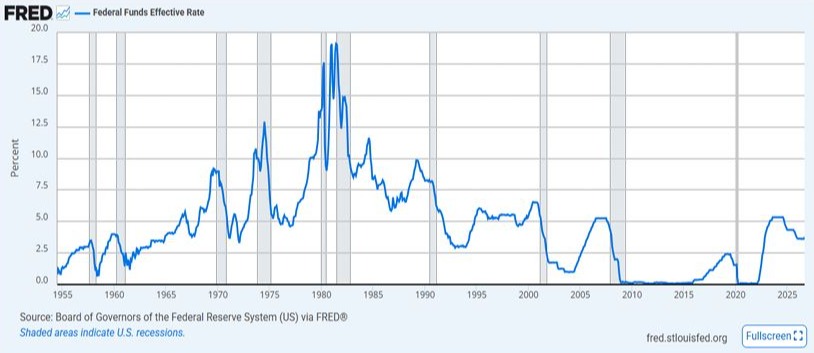
But those economic adjustments can take years to unfold, and we don’t think markets have yet fully adjusted to a world where capital has become more expensive.
Real estate markets are one example. The recent rise in rates could justify meaningful declines in property values across many commercial property sectors. For owners with mortgages, the impact on equity can be much greater. Yet because most real estate is privately held and reprices slowly, we suspect a substantial portion of that adjustment may still lie ahead.
Junk debt is another area we are closely watching. CCC-rated bonds now yield nearly 17%, up from roughly 12% a year ago. As more of this debt comes due, we estimate that many of these borrowers – which represent about 8% of the high-yield market – may no longer be viable at today’s refinancing rates.
And then there is the largest borrower of all, the US Treasury. If the government’s average borrowing cost eventually rises from roughly 3.4% toward 5%, annual interest expense would increase by about $500 billion – adding enormous pressure to the federal budget.
BHPW POSITIONING
So, as we seem to say every quarter, the list of risks keeps getting longer. How are we navigating them?
In equities, we remain defensively positioned. That means not only staying well diversified, but also emphasizing companies with healthy balance sheets, stable business profiles, and strong free cash flow generation. We estimate our common stock portfolio offers a payout yield of roughly 5% from dividends and share repurchases, which compares favorably with the 2.4% we mentioned earlier for the S&P 500. We believe that higher payout should provide some cushion in the event of a market decline.
Meanwhile, in bonds, we continue to emphasize strong credit quality while keeping the portfolio’s average maturity in the intermediate range. With few investors eager to extend maturities here, we may be closer to the end of the recent rate adjustment than the beginning. But for now, we are keeping our duration around benchmark levels, relying on security selection and higher yields to help weather the volatility.
Stepping back, whether yields are 5.5% or 6.5% for the next five years, we view both as attractive fixed income opportunity sets. Short-term price declines may be uncomfortable, but they do not change the underlying cash flows or the returns those yields should produce for investors who hold these portfolios over time.
CONCLUSION
Markets continue to accumulate risks, with more dislocation beneath the surface than the headline indices would suggest. But those same dislocations are creating attractive opportunities across both equities and fixed income. Our job is to distinguish between the risks worth taking and those best avoided.
Ultimately, it is the returns available from today’s prices, not yesterday’s performance, that matter most. And from that perspective, we continue to find investments where we believe the odds are strongly in our favor across both asset classes, offering not only attractive prospective returns but also meaningful downside protection should markets turn against us.
As always, thank you for your continued trust and confidence.
Beverly Hills Private Wealth, LLC is a registered investment adviser. This is solely for informational purposes. No advice may be rendered by Beverly Hills Private Wealth, LLC unless a client service agreement is in place.
Opinions expressed are subject to change without notice and are not intended as investment advice or to predict future performance. The economic forecasts set forth in the presentation may not develop as predicted and there can be no guarantee that strategies promoted will be successful. Past performance does not guarantee future results. Investing involves risk, including loss of principal. Consult your financial professional before making any investment decision. Other methods may produce different results, and the results for different periods may vary depending upon market conditions and portfolio composition. This newsletter does not represent an offer to buy or sell securities.