
BHPW Newsletter Q2 2026
MARKET RECAP
Stocks surged during the second quarter, posting double-digit returns that more than recouped the year's earlier losses. It was the strongest quarter for global equities since the pandemic rebound of Q2 2020. And while the gains were widespread across much of the market, Technology was the clear standout, returning +44.5% for the quarter. Certain AI-related segments, particularly semiconductor stocks, performed even better, raising fresh concerns that expectations may have gotten ahead of the fundamentals. Following this rally, the MSCI ACWI was up +11.3% for the first half of the year, while the S&P 500 was up +10.2%.
Bonds faced a more challenging backdrop. Higher oil prices, a resilient US economy, and heavy AI infrastructure spending all fueled concerns about inflation, pushing interest rates higher and prices lower. The result was a -0.2% year-to-date return for global bonds and a +0.6% gain for their US counterparts.
For our part, our portfolios performed well in this environment, with equity returns largely falling between the US and global benchmarks over this six-month period. Our defensive posture helped during the first quarter’s market decline, while our diversified holdings captured less of the second quarter’s concentrated rally. Even so, we are pleased with our double-digit start to the year, particularly given our downside capture of just 55%. 1
In fixed income, our bond models outperformed both benchmarks due to strong selection. Some of that benefit was offset by rate headwinds in our longer-duration positions. With interest rates near what we believe to be their medium-term highs, we see an attractive setup for bonds in the second half. More on that later.
CONCENTRATED MARKETS
Investors often think of the S&P 500 as a diversified portfolio of companies. Yet despite still holding 500 businesses, a growing share of the index is now concentrated in its AI-related segments. As a result, performance has become heavily tied to the fortunes of this single investment theme, introducing new risks and amplifying volatility. 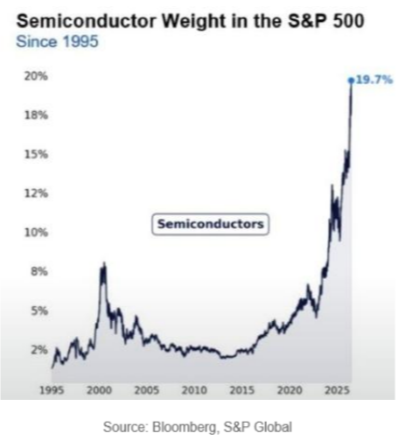
The clearest example of this is semiconductors, which now make up nearly 20% of the index. That is notable because the industry is also among the most cyclical and expensive in the market, with a recent beta of approximately 2.5x and a weighted-average P/E ratio of roughly 42x.
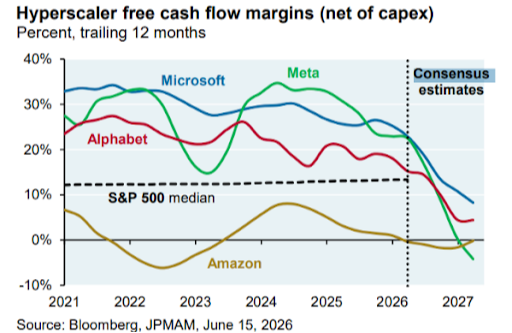
Meanwhile, just six other companies account for an additional 25% of the index. Collectively, they are the world's largest spenders on AI, investing hundreds of billions of dollars each year in its infrastructure buildout. In the process, these companies once known for their abundant free cash flow have become some of the world’s most capital-intensive businesses.
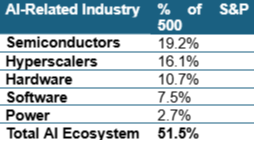
Beyond those two is a broader set of software, power, and other AI-related businesses. Altogether, companies with ties to the AI ecosystem now represent over half of the S&P 500.
CONCENTRATED RETURNS
Returns this year have been even more concentrated than the index weightings. In fact, 93% of the S&P 500's first-half gains came from AI-related companies. The chart below shows the breakdown by segment.
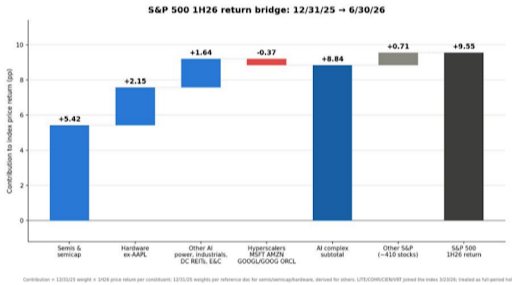
Note: This chart is based on the S&P 500's first-half price return of 9.55%, excluding dividends.
This helps explain why the market has felt more volatile than the headline indexes suggest. On some days, semiconductor stocks led the market higher. On others, investors favored the hyperscalers spending heavily on AI. Still at other times, leadership swung back toward the rest of the market – the "S&P 410" – as investors grew more skeptical of the AI outlook. Market leadership has rotated rapidly between these three groups as the AI narrative has shifted.
Interestingly, two of these camps frequently sit at odds with one another. Semiconductor stocks benefit from increased AI investment, while hyperscalers tend to do well when investors see signs of greater capital discipline. In the short run, changes in the AI spending outlook have moved these two large groups in opposite directions.
Of course, in the long run, it’s entirely possible that both sides “work” and deliver on their promise. It’s also conceivable that only one succeeds – or that neither does. Either way, an unusually large portion of today's market now depends on how this narrative plays out.
INVESTING BEYOND ONE THEME
"You can be wrong [as an investor]—and, in certain industries, your risk of being wrong is higher. Technology is one of those areas." – Chris Hohn, Founder of TCI Fund Management
Our philosophy has never been to build portfolios around a single investment thesis. Instead, we believe portfolios should be constructed to succeed across a range of possible outcomes. That means diversifying across several industries, geographies, and business drivers – and not relying too heavily on any one idea.
That diversification is particularly relevant today, given how much of the indexes have become tied to Technology. Fortunately, we continue to find attractive opportunities across a much broader swath of the market. The treemaps below show how our equity positioning compares with the S&P 500.
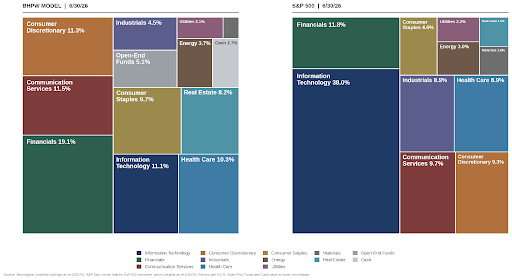
Perhaps most importantly, our approach has not come at the expense of returns. Year to date, six of our twelve portfolio sectors2 have generated returns of more than 20%, led by less glamorous areas like Energy, Utilities and Real Estate. And since implementing our current models at BHPW in 2023, nine of those twelve categories have delivered annualized returns of 20% or better.
Underappreciated (so far) has been the value of those independent return drivers. But if Technology were to stumble, we feel confident that our breadth would provide meaningful downside protection. At the same time, we would still expect to generate attractive returns even if today’s dominant AI theme plays out. After all, AI-related businesses already account for more than half of the benchmark, meaning the market is pricing in an enormous amount of their future growth. We’re not convinced that stocks priced at those levels will ultimately reward investors.
LOOKING AHEAD
The second half of the year will almost certainly bring new questions surrounding AI spending, inflation, interest rates, and the broader economy. Below, we highlight a few of the key risks we are watching.
For starters, the economic expansion is certainly getting long in the tooth. Aside from a few brief disruptions, the last truly extended downturn ended more than 17 years ago. That does not mean another one is imminent, but long periods of stability have a way of making investors forget that cycles still exist. With signs of stress emerging in the labor market and consumer budgets, the economy may be more vulnerable to disappointment than it has been in some time.
Geopolitical risks add another layer of uncertainty. From our vantage point, tensions surrounding Iran and the Strait of Hormuz remain unresolved and could continue to affect energy prices – and, by extension, inflation and interest rates. The recent decline in oil prices appears to have bred a degree of complacency, but the two sides remain far apart on several key issues. As recent events have shown, we do not think we are out of the woods quite yet.
AI is likely to remain another source of volatility. Memory has recently become one of the market’s hottest areas, with shortages driving prices several times higher in a relatively short period. That may persist for a while, but we’d expect unusually high prices to invite a response – whether through producers adding capacity, customers seeking alternatives, or engineers simply finding ways to use less. With the three largest memory producers expected to rank among the world’s most profitable companies in the third quarter – each ahead of even Microsoft and Apple – there is no shortage of incentive to find a workaround. As a mentor often quoted from Jurassic Park: “Life finds a way.”
BHPW POSITIONING
Given the above, how are we positioning for the road ahead?
In equities, we continue to find several opportunities that meet our return targets. Recently, we added two new investments with ties to AI, though neither is a semiconductor company nor a hyperscaler. The first is an independent power producer that we have owned quite successfully in the past. Following a recent pullback, shares traded at approximately 9x our estimate of normalized free cash flow, providing an attractive re-entry point into a business benefiting from growing electricity demand. The second is a global leader in electrical and data connectivity solutions. Despite strengthening AI-related demand and a sharp increase in its order backlog, shares still trade at approximately 16x our estimate of normalized earnings.
Elsewhere, we are finding compelling special situations. For example, last quarter we purchased a mutual fund with a significant SpaceX position still valued at its pre-IPO valuation. We benefited from the initial repricing and subsequent post-IPO share appreciation before exiting at what we believed was its full value. More recently, we have been adding a real estate company undergoing liquidation, where index-related selling has created a meaningful disconnect between the share price and the value of its underlying assets.
In fixed income, the landscape has also improved materially. We are routinely finding securities yielding between 6.5% and 9.0% that meet our safety standards. Most are investment grade, and several are among the earliest maturities in the issuer’s capital structure. While our overall positioning remains conservative – with more than 70% still invested in government-backed, AAA-rated, or municipal securities – we have selectively increased our credit exposure where we view the risk/reward as compelling. With interest rates unlikely to move significantly higher from here, we believe the backdrop for bonds is among the best we’ve seen in years.
CONCLUSION
Markets rarely move in a straight line, and the second half of the year will certainly bring its fair share of surprises. That’s the price of admission for long-term investing.
That said, we continue to find attractive investments across both equities and fixed income that we believe offer a favorable balance of return potential and downside protection. We cannot say the same for the broader indexes. Elevated valuations, lofty expectations, and increasingly narrow leadership leave less room for error and could make the next setback far more consequential. In our view, that places an even greater premium on disciplined selection.
Thus, our focus remains unchanged. We will continue to allocate client capital selectively, with the diversification and prudence required to succeed across a wide range of outcomes. With more than half of the index now tied to a single theme, we believe that approach is more important than ever.
As always, thank you for your continued trust and confidence.

Beverly Hills Private Wealth, LLC is a registered investment adviser. This is solely for informational purposes. No advice may be rendered by Beverly Hills Private Wealth, LLC unless a client service agreement is in place.
Opinions expressed are subject to change without notice and are not intended as investment advice or to predict future performance. The economic forecasts set forth in the presentation may not develop as predicted and there can be no guarantee that strategies promoted will be successful. Past performance does not guarantee future results. Investing involves risk, including loss of principal. Consult your financial professional before making any investment decision. Other methods may produce different results, and the results for different periods may vary depending upon market conditions and portfolio composition. This newsletter does not represent an offer to buy or sell securities.
1 Downside capture measures how much of a market decline a portfolio participates in. A 55% downside capture means the portfolio participated in only about half of the market's losses during periods when markets declined.
2 The eleven GICS sectors plus an “Other” category for diversified funds and ETFs